Apis Mellifera: Cunmont
First seek a settled home for your bees, whither the winds may find no access — for the winds let them not carry home their food — where no ewes or sportive kids may trample the flowers, nor straying heifer brush off the dew from the mead and bruise the spring blade.—Virgil
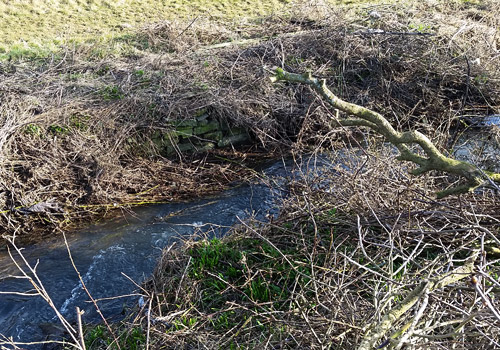
Cunmont lies at the foot of the wooded cap of Cunmont Hill and is defined largely by Cunmont House and Cunmont Farm. From satellite pictures you can still make out traces of a mill path from Drumsturdy Road (the Turnpike Road) travelling North by West (Grid reference: NO495355) to the 'thrashing mill' [sic] (National Library of Scotland) next to the Buddon burn at Templelands (Grid reference: NO495357). The path continues on the same trajectory over the remains of a bridge (shown below) across arable land, finally connecting with the existing section of the mill path ending at what is known locally as Cunmont Road (Grid reference: NO494362). Hedged in Oak, Sycamore, Chestnut, Hawthorn and Dog Rose, this slightly neglected private access road connects both Cunmont House and Cunmont Farm to the outside world via Pitairlie Road and Cunmont Quarry Road.
The house itself is a late Georgian mansion built in 1834 by the architect George Mathewson (1809-1873) for Thomas Kerr of Grange (-1879). It was later occupied by James Henry Langlands (1861-1932), an architect and apiarist; some beehives can still be seen in the wooded area bordering a stretch of arable land at the gable end of the house .
This area was not always known as Cunmont. The name makes its first appearance on a six inch ordinance survey map dated 1888-1913 (National Library of Scotland), while on ordinance survey maps pre-dating 1888 (National Library of Scotland) the area is referred to as Newbigging: meaning a building, cottage or cluster of houses (Dictionary of the scots Language, 2017). This is undoubtedly a reference to Cunmont farm, one of the more recent farms in historical terms.
A satisfying interpretation of the name Cunmont remains elusive. It is a compound of two words: Cun and Mont. Cun can mean: to taste or give thanks (Dictionary of the Scots Language, 2017) or to use an older definition means: to know (A Dictionary of the Older Scottish Tongue, 2017). The word Mont generally refers to a mountain or hill. (A Dictionary of the Older Scottish Tongue, 2017). However Cun could be derived from coning or cuning, which is old scots for rabbit. (Scots Words and Placenames). This interpretation has some credibility given the physical terrain of this area.
References
"Mont n.". Dictionary of the Scots Language. 2004. Scottish Language Dictionaries Ltd. Accessed 24 Apr 2017 http://www.dsl.ac.uk/entry/dost/mont_n
"Cun v.". Dictionary of the Scots Language. 2004. Scottish Language Dictionaries Ltd. Accessed 24 Apr 2017 http://www.dsl.ac.uk/entry/dost/cun
"Cun v.2". Dictionary of the Scots Language. 2004. Scottish Language Dictionaries Ltd. Accessed 24 Apr 2017 http://www.dsl.ac.uk/entry/snd/cun_v2
"Cun v.1". Dictionary of the Scots Language. 2004. Scottish Language Dictionaries Ltd. Accessed 24 Apr 2017 http://www.dsl.ac.uk/entry/snd/cun_v1
"Biggin(g) n.2". Dictionary of the Scots Language. 2004. Scottish Language Dictionaries Ltd. Accessed 24 Apr 2017 http://www.dsl.ac.uk/entry/snd/bigging
Aberdeen University, The Aberdeen Bestiary, 2017, Folio 63R, https://www.abdn.ac.uk/bestiary/ms24/search?q=bees
Fairclough, H. R. n.d. Virgil Georgics. Theoi Classical Texts Library Available from: http://www.theoi.com/Text/VirgilGeorgics2.html#4
National Library of Scotland, 2017, Forfarshire Sheet LI.SW, Surveyed: 1900, Published: 1903, http://maps.nls.uk/geo/explore/#zoom=16&lat=56.5145&lon=-2.8187&layers=6&b=2
DSA Architect Biography Report (April 21, 2017, 10:35 am), http://www.scottisharchitects.org.uk/architect_full.php?id=201246
DSA Architect Biography Report (April 21, 2017, 10:36 am), http://www.scottisharchitects.org.uk/building_full.php?id=421796
Scots Words and Placenames (June 8, 2017, 12.07) http://swap.nesc.gla.ac.uk/database/?view=table&search=cun
Bibliography
Fallon, Peter. (2009) Virgil Georgics. London. Oxford University Press.
Smout, T.C. (1989) A History of the Scottish people. London. Fontana Press.
Graham, H.Grey. (1937) The Social life of Scotland in the eighteenth century. London. A&C Black Ltd.
Alciato at Glasgow, http://www.emblems.arts.gla.ac.uk/alciato/